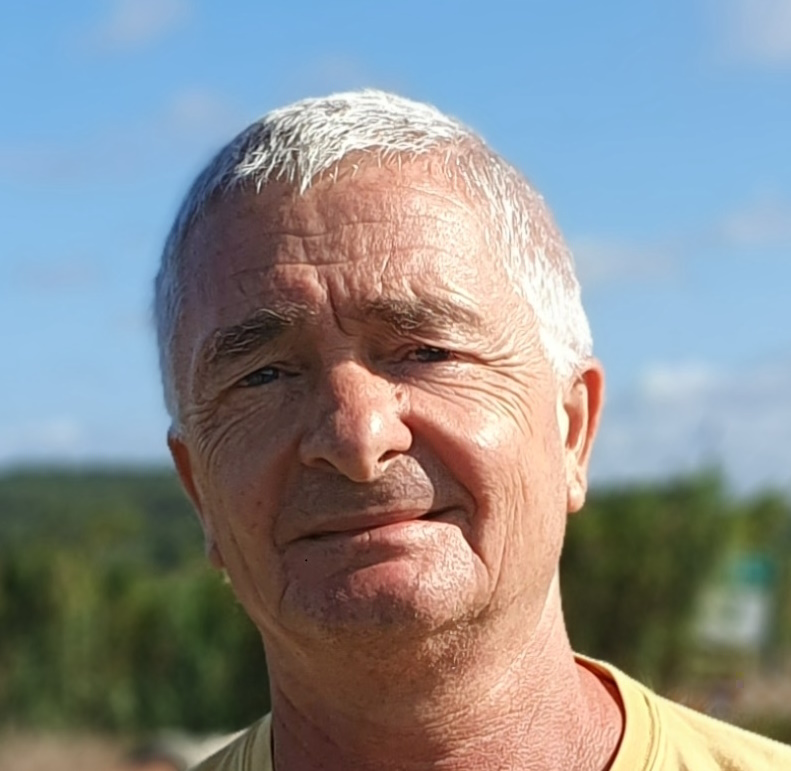
|
|
Last Update: 29/07/2026
|
Luis Filipe Veiros
Associate Professor
(b. 1963)
|
|
|
Contacts
Departamento
de Engenharia Química
Instituto
Superior Técnico
Universidade de Lisboa
Av. Rovisco Pais
P - 1049-001 Lisboa
Portugal
Telefone: (+351) 21 841 92
83 (ext.: 3283)
Fax: (+351) 21 846 44 55

Education
Scientific
Interests
Utilização
dos modernos métodos de Química Quântica Computacional
para o estudo de problemas de estrutura e
reactividade em química orgânica e em química
organometálica de metais de transição.
Cálculos
de orbitais moleculares podem ser usados para estudar
a estrutura molecular e a reactividade química dos
compostos. Os resultados obtidos permitem compreender
e racionalizar as alterações estruturais sofridas
pelas espécies em estudo, resultantes de modificações
na respectiva estrutura electrónica. Num complexo
organometálico, por exemplo, é possível estudar as
alterações do modo de coordenação de alguns ligandos
que ocorrem quando muda o número total de electrões na
esfera de coordenação do metal. Estes processos podem
resultar de uma simples oxidação ou redução da
espécie, ou da adição ou eliminação de ligandos, e
estão na base de importantes reacções em química
organometálica, tais como reacções catalíticas.
Por outro lado, a natureza teórica dos métodos permite
o estudo de espécies muito reactivas, ou mesmo
instáveis em condições experimentais, tais como
estados de transição ou intermediários com tempos de
vida muito curtos. Desta forma, é possível estudar ao
pormenor mecanismos de reacções, obtendo-se informação
detalhada sobre o percurso reaccional e a respectiva
energética.
Computational
Methods
Nos cálculos de
orbitais moleculares usam-se métodos ab initio
e DFT para obter resultados de natureza quantitativa,
tais como geometrias e energias. A interpretação
química destes resultados pode ser conseguida através
de análise populacional e orbital.
Teaching
Assignments (2025/2026)
Selected
Publications
"Mechanism for the Cyclotrimerization of
Alkynes and Related Reactions Catalyzed by
CpRuCl.";
Karl Kirchner, Maria José Calhorda,
Roland Schmid, Luís F. Veiros;
Journal
of the American Chemical Society 2003 125, 11721–11729.
"Zirconium bis(indenyl) sandwich complexes with an
unprecedented indenyl coordination mode and their
role in the reactivity of the parent bent
metallocenes. A detailed DFT mechanistic study.";
Luís F. Veiros;
Chemistry
- A European Journal 2005, 11, 2505–2518.
“Iron(II)
Bis(acetylide) Complexes as Key Intermediates in the
Catalytic Hydrofunctionalization of Terminal Alkynes”
Nikolaus Gorgas, Berthold Stöger, Luis F. Veiros,
Karl Kirchner;
ACS
Catalysis 2018, 8
(9), 7973–7982.
Recent
Publications
“Pd-Catalyzed C(sp2)−H/C(sp2)−H Coupling of
Limonene”
Marco Di Matteo, Anna Gagliardi, Alexandre
Pradal, Luis F. Veiros, Fabrice
Gallou, Giovanni Poli;
The Journal of
Organic Chemistry 2024, 89
(15), 10451–10461.
“Hydroboration of Terminal Alkynes Catalyzed
by a Mn(I) Alkyl PCP Pincer Complex following
Two Diverging Pathways”
Daniel P. Zobernig, Berthold Stöger, Luis
F. Veiros, Karl Kirchner;
ACS Catalysis
2024, 14 (16), 12385–12391.
“Hydrogenation of Alkenes Catalyzed by Mn(I)
Alkyl Complexes Bearing NHC Phosphine Ligands”
Daniel P. Zobernig, Berthold Stöger, Luis
F. Veiros, Karl Kirchner;
ChemCatChem 2024,
16 (22), e202401172.
“Alkene Isomerization Catalyzed by a Mn(I)
Bisphosphine Borohydride Complex”
Ines Blaha, Stefan Weber, Robin Dülger, Luis
F. Veiros, Karl Kirchner;
ACS Catalysis
2024, 14 (17), 13174–13180.
“C-P Bond Cleavage Through Hydrogenation in
Ruthenium Complexes Supported by P,N Ligands”
Vanessa R.G. Cacho, Luís F. Veiros,
Clara S. B. Gomes, Mariana Sardo, Cláudia A.
Figueira, Ana M. Martins, Maria João
Ferreira;
Inorganic
Chemistry 2024, 63
(49), 23421–23430.
“Monoterpenoid Selenophenes Derived from
(-)-Carvone with GPx-like activity”
João P. Telo, Luis F. Veiros, Vânia
André, João Ferreira da Silva, Gonçalo C.
Justino, Alexandra M. M. Antunes;
Organic &
Biomolecular Chemistry 2025, 23
(9), 2153–2161.
“Borane-Tethered Heteroscorpionate Zinc
Catalysts for the Hydroboration of Carbon
Dioxide, Isocyanates, Esters and Nitriles”
Tiago F. C. Cruz, Luís F. Veiros;
Dalton
Transactions 2025, 54 (10),
4244–4254.
“Protecting Group-Free Photocatalyzed
O-Arylation of Quinic Acid”
Miguel A. Bárbara, Nuno R. Candeias, Luis
F. Veiros, Filipe Menezes, Andrea
Gualandi, Pier
G. Cozzi, Carlos A. M. Afonso;
Tetrahedron Green
Chem 2025, 5, 100070.
“Unexpected formation of neutral alkyl-Ni(II)
complexes bearing unsymmetrical C,N,N’-pincer
iminopyrrolyl ligands via intramolecular C-H
bond activation: a distinct type of
single-component ethylene polymerization
catalysts”
Cláudia A. Figueira, Patrícia S. Lopes,
Ricardo Meyrelles, Clara S. B. Gomes,
Joselaine C. S. Gomes, Luís F. Veiros,
Pedro T. Gomes;
Inorganic
Chemistry 2025, 64
(50), 24479–24496.
“Controllable Hydrosilylation and
Dehydrogenative Silylation of Alkenes
Catalyzed by a Manganese Alkyl Complex”
Daniel P. Zobernig, Luis F. Veiros,
Karl Kirchner;
Organometallics
2026, 45 (14), 1731–1739.
|
|
|